The Solemnity of the Most Holy Trinity

“God so loved the world that he gave his only Son,

so that everyone who believes in him might not perish

but might have eternal life.

For God did not send his Son into the world to condemn the world,

but that the world might be saved through him.

Whoever believes in him will not be condemned,

but whoever does not believe has already been condemned,

because he has not believed in the name of the only Son of God.”

– John 3:16-18 – 

Today’s reading from John’s Gospel is perhaps the most quoted Scripture passage. John 3:16. And today, we celebrate the Solemnity of the Most Holy Trinity. You might be asking yourself, “What does this passage have to do with the Holy Trinity?”. This is an important question we should address as we read this passage today.

So what is the Trinity? The Trinity is the Father, the Son, and the Holy Spirit. We have the lover (the Father), the beloved (the Son), and the love that exists between the Father and the Son (the Holy Spirit). 

Now let’s take a look at the Gospel. 

“God so loved the world” – God the Father (the lover)

“That he gave his only Son” – God the Son (the beloved)

It is pretty easy to see where the Father and the Son are present in the passage but where is the Holy Spirit? It is present between the Father and the Son. The Father “so loved the world that he gave his only Son”. God did not send anyone. God sent His only Son. The Son accepted God’s mission and returned God’s love. The love between them is always present. 

C.S. Lewis on the Trinity:

“You know that in space you can move in three ways – to left or right, backwards or forwards, up or down. Every direction is either one of these three or a compromise between them. They are called the three Dimensions. Now notice this. If you are using only one dimension, you could draw only a straight line. If you are using two, you could draw a figure: say, a square. And a square is made up of four straight lines. Now a step further. If you have three dimensions, you can then build what we call a solid body: say, a cube – a thing like a dice or a lump of sugar. And a cube is made up of six squares.

Do you see the point? A world of one dimension would be a straight line. In a two-dimensional world, you still get straight lines, but many lines make one figure. In a three-dimensional world, you still get figures but many figures make one solid body. In other words, as you advance to more real and more complicated levels, you do not leave behind you the things you found on the simpler levels: you still have them, but combined in new ways – in ways you could not imagine if you knew only the simpler levels.

Now the Christian account of God involves just the same principle. The human level is a simple and rather empty level. On the human level one person is one being, and any two persons are two separate beings – just as, in two dimensions (say on a flat sheet of paper) one square is one figure, and any two squares are two separate figures. On the Divine level you still find personalities; but up there you find them combined in new ways which we, who do not live on that level, cannot imagine. In God’s dimension, so to speak, you find a being who is three Persons while remaining one Being, just as a cube is six squares while remaining one cube. Of course we cannot fully conceive a Being like that: just as, if we were so made that we perceived only two dimensions in space we could never properly imagine a cube. But we can get a sort of faint notion of it. And when we do, we are then, for the first time in our lives, getting some positive idea, however faint, of something super-personal – something more than a person. It is something we could never have guessed, and yet, once we have been told, one almost feels one ought to have been able to guess it because it fits in so well with all the things we know already.” (Harper Collins version, p161-162)

Prayer

Come, Holy Spirit,

fill the hearts of your faithful,

and enkindle in us the fire of your love.

Send forth your Spirit and we shall be created,

and you shall renew the face of the earth.

Amen.

This reflection was inspired by Bishop Barron. You can find his full reflection here:

C.S. Lewis on the Trinity:

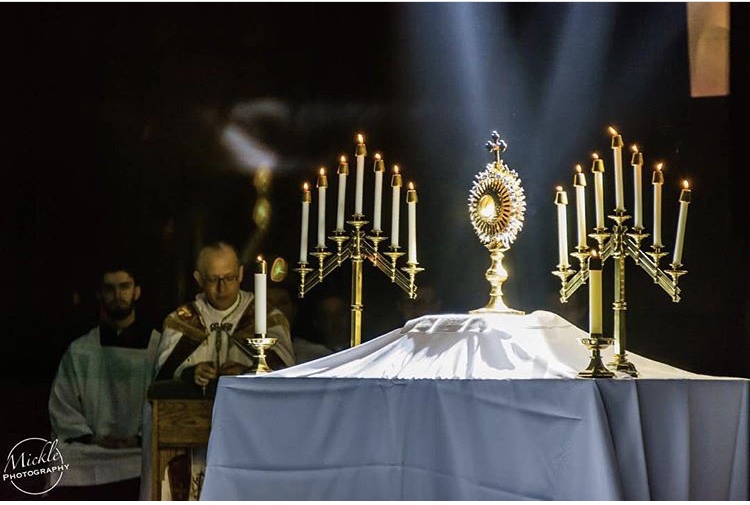
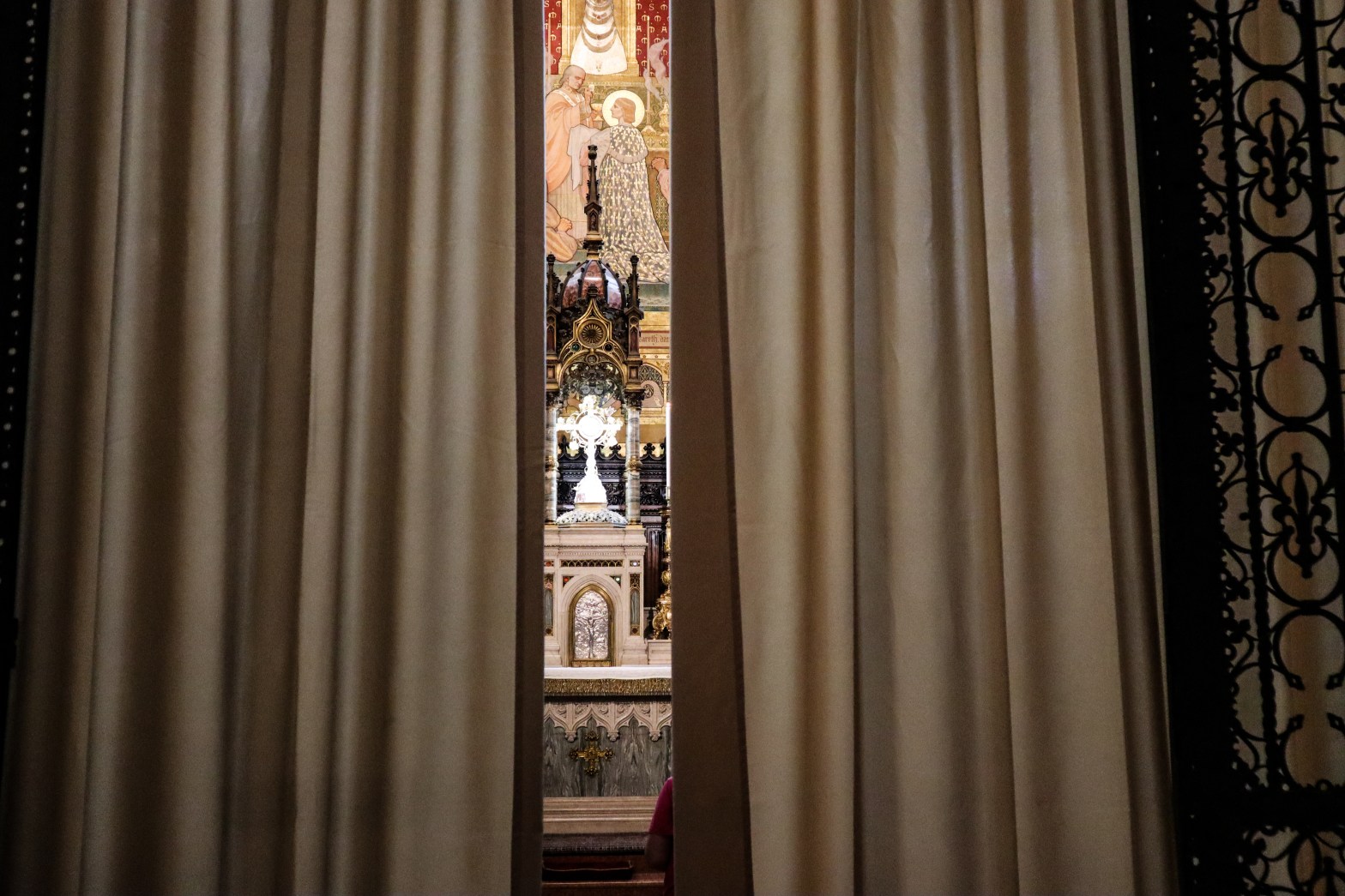
What is Eucharistic Adoration?

Photo by Mickle Photography

Firstly, the Eucharist is the true Presence of Jesus Christ in the form of bread and wine. 

Eucharistic Adoration is the “practice of worship/praying before Jesus Christ in the Blessed Sacrament exposed in a monstrance on an altar” (eucharisticadorationadelaide.org). 

Saints on Eucharistic Adoration:

  • “Of all devotions, that of adoring Jesus in the Blessed Sacrament is the greatest after the Sacraments, the one dearest to God and the one most helpful to us.” – St. Alphonsus Liguori
  • “This is the wonderful truth, my dear friends: the Word, which became flesh two thousand years ago is present today in the Eucharist.” – St. Paul II
  • “When you look at the crucifix, you understand how much Jesus loved you then. When you look at the Sacred Host, you understand how much Jesus loves you now.” – St. Teresa of Calcutta
  • “We must always have courage, and if some spiritual languor comes upon us, let us run to the feet of Jesus in the Blessed Sacrament, and let us place ourselves in the midst of the heavenly perfumes, and we will undoubtedly regain our strength.” – St. Padre Pio
  • “The soul hungers for God, and nothing but God can satiate it. Therefore He came to dwell on earth and assumed a Body in order that this Body might become the Food of our souls.” – St. John Vianney

Prayer to the Sacred Heart of Jesus

O most holy Heart of Jesus, fountain of every blessing,

I adore you, I love you and will a lively sorrow for my sins.

I offer you this poor heart of mine.

Make me humble, patient, pure, and wholly obedient to your will.

Grant, good Jesus, that I may live in you and for you.

Protect me in the midst of danger; comfort me in my afflictions;

give me health of body, assistance in my temporal needs,

your blessings on all that I do, and the grace of a holy death.

Within your heart I place my every care.

In every need let me come to you with humble trust saying,

Heart of Jesus, help me.

Amen.

Sources: 

Other helpful resources:

How Can we Call Someone a ‘Saint’?

Critics of the Church may sometimes point out the absurdity of naming someone a saint. “Surely they lived a good life,” the argument begins, “but how can we possibly claim that a person has been saved?”⁣

Let’s begin by recalling what a saint is. Indeed saints are people like Franics, Paul, Ignatius – those famous people we have honored throughout history – but also all those who happily enjoy eternal life with the Father. Anyone can be a saint – your grandmother, friend, or even your fourth-grade teacher! The Church however, in hoping to provide an example for us to strive towards, making known those Christians who have eclipsed the marks of ordinary personhood. People who have strived valiantly for holiness and who pass through the Church’s standards for sainthood are officially canonized as saints.⁣

When a person has a profound impact on those around them, the bishop of that person’s diocese may desire to look into that individual’s life in order to determine the sort of life that person led. We might call the aura of respect around a person “fame of sanctity” or “fame of martyrdom”. The bishop submits the information he has collected to the Vatican’s Congregation for the Causes of Saints, and a person, if accepted, would then be named a Servant of God. For example, the co-founder of the Catholic Worker, Dorothy Day, is currently classified as a Servant of God.⁣

The next step involves determining the person’s character while on Earth, essentially asking the question: “did this person’s heart strive towards good?” The Church examines the person’s actions and attitudes, ensuring that she or he was living up to the moral standards set by those who came before them. If the candidate clears this process, they are deemed Venerable. Fulton Sheen, the wildly famous Archbishop of the new media, fits this category.⁣

The next step, beatification, is only attainable via the confirmation of a miracle, believed to be attributed via the intercession of that person. The rationale behind this step is that the person is indeed enjoying the splendor of Heaven and intercessing for us who remain on Earth. Miracles must be reviewed by a group of scientists, then theologians, and finally the Pope. Jerzy Popiełuszko, a Polish priest and martyr, is currently recognized as a Blessed or Beatified.⁣

Finally, if one has a second miracle attributed to their personhood, the Church declares them a saint. The process is indeed long and particular, but the Church desires to have the utmost clarity in making such a determination. And remember, this process is for the formal declaration of a recognized saint. The whole of the community of saints does not experience such scrutiny. Indeed, we know not the number saved, but the Church can offer us exemplary individuals who have demonstrated an ability to connect humankind to the Father in a unique way.⁣

This article could not have been possible without the following sources: https://www.catholiceducation.org/en/culture/catholic-contributions/the-process-of-becoming-a-saint.html https://focusoncampus.org/content/how-does-someone-become-a-saint-a-5-step-process http://www.usccb.org/about/public-affairs/backgrounders/saints-backgrounder.cfm

Blog: Houseflies and Windowpanes

Today, I had the experience of watching some house flies attempt to escape a building by flying into a pane of glass. The bugs would aim at the outside world, charge full speed ahead, but only to get knocked back by the window that separated them from the outside world. Confused, the flies would crawl up the glass, trying to make sense of this odd material separating them from the outside world they longed to experience. Thinking some exit must be close, they searched up and down the window, never quite finding an exit. The process was at first comical, but soon turned contemplative.⁣

The events of the past week, which have called to light a persistent problem in our world, the daze of the ongoing pandemic, and a few tragedies that have surrounded my life has me feeling weary. Weary is not quite the adjective one hopes to express in the week following Pentecost, the great jubilee and birth of the Church, but life finds me tired. The otherside of these tragedies are visible in some sense. I can imagine a world free of prejudice. Lands expelled of disease. Hearts comforted. Heartbreak undone.⁣

Yet it seems to me that my vision, and my path to that vision, may be just as superfluous as the flies’ attempts at escaping through a pane of glass. What at first glance presents itself as the easy solution may indeed not be so.⁣

The fourth chapter of Saint John’s Gospel famously describes Christ’s encounter with the “Woman at the Well.” The woman arrives at the place to draw life-sustaining water out from the well. Her path towards satisfaction was quite obvious: approach the well, draw some water, and be on her way. It is here, however, that Jesus intersects the woman’s story. He offers something and a path – far different from what the woman had been expecting.⁣

In responding to the woman’s inquiries about Christ’s “life-giving water,” he hits her with a difficult truth: her sin. Jesus doesn’t simply stop there however. He offers the following prophecy: “the hour is coming, and is now here, when true worshippers will worship the Father in Spirit and in truth; and indeed the Father seeks such people to worship him. God is Spirit, and those who worship him must worship in Spirit and truth” (Jn 4:23-24).⁣

When I reflect on this event in the wake of the events of the past week, I can only stop, breathe, and reflect on how I have mirrored the image of the woman. I have longed – for respite, comfort, and peace – from the tumult of the coronavirus pandemic, and in my search encountered so much more. The tragic death of George Floyd in the midst of all this charges me to examine my own life and how I have failed to stand in solidarity with my Sisters and Brothers in Christ. Truth is a cardinal indicator of the goodness of God, and the truths rendered by this past week are indeed revealing a path of sorts for Christians to journey upon.⁣

If only the flies knew that the door was only a five-seconds flight away from the window, they would have escaped to the otherworld they desired. Sure, they had to fly backwards and thus to move away from their vision of the future, but that was the only path to what they desired. If my desire in this moment is for peace, then I ought to expand what it means to experience interior peace. Peace goes beyond being able to venture outside with fearing for illness; it means being able to attain true social justice, to stand in solidarity with others, to experience discomfort for some future comfort. All it takes to achieve this peace is to trust in Another’s plan.⁣

Let Us Love One Another

Cover Photo: Luis Quintero

Usually today I would write a blog post about some topic related to my faith journey or something relating to Catholicism.

That is not why I am writing today.

I am writing to you to express the sadness and heartbreak I feel over the recent events in our country. The senseless murder of George Floyd has sparked protests around the country and rightly so. 

For too long, our nation has allowed systemic oppression and racism to permeate our society. Enough is enough. The time to change is now. 

As a white man, I am far too uninformed. I am frustrated at how ignorant I have been…to police brutality, to racism, to the sufferings of my brothers and sisters who bear a different skin color. 

I must educate myself. I must learn. I must not be ignorant of the injustices in our society. No one in this world should be treated unfairly because of the color of their skin. No one. We must all do our part to ensure that this does not continue. We must root out racism entirely. 

As Nelson Mandela once said:

“No one is born hating another person because of the color of his skin, or his background, or his religion. People must learn to hate, and if they can learn to hate, they can be taught to love, for love comes more naturally to the human heart than its opposite.”

Now more than ever we must show one another what it means to love. We must teach each other to love. 

“Racism is a sin; a sin that divides the human family, blots out the image of God among specific members of that family, and violates the fundamental human dignity of those called to be children of the same Father. Racism is the sin that says some human beings are inherently superior and others essentially inferior because of races. It is the sin that makes racial characteristics the determining factor for the exercise of human rights. It mocks the words of Jesus: “Treat others the way you would have them treat you.” Indeed, racism is more than a disregard for the words of Jesus; it is a denial of the truth of the dignity of each human being revealed by the mystery of the Incarnation.”

Brothers and Sisters to Us, U.S. Catholic Bishops, 1979.

Let us come together as one family in Christ. Let us recognize that we are all brothers and sisters. No race is superior to another. We are all human. We are all children of God. Let us focus on what unites us.

God’s creation is beautifully diverse but ultimately united. 

Good and gracious God, you invite us to recognize and reverence your divine image and likeness in our neighbor.  Enable us to see the reality of racism and free us to challenge and uproot it from our society, our world and ourselves.

In Jesus’ name we pray,

Amen

Link to prayer source: https://www.sistersofmercy.org/resources/prayer-the-elimination-of-racism/

Gospel Reflection – Pentecost Sunday 5/31

“𝘖𝘯 𝘵𝘩𝘦 𝘦𝘷𝘦𝘯𝘪𝘯𝘨 𝘰𝘧 𝘵𝘩𝘢𝘵 𝘧𝘪𝘳𝘴𝘵 𝘥𝘢𝘺 𝘰𝘧 𝘵𝘩𝘦 𝘸𝘦𝘦𝘬,⁣
𝘸𝘩𝘦𝘯 𝘵𝘩𝘦 𝘥𝘰𝘰𝘳𝘴 𝘸𝘦𝘳𝘦 𝘭𝘰𝘤𝘬𝘦𝘥, 𝘸𝘩𝘦𝘳𝘦 𝘵𝘩𝘦 𝘥𝘪𝘴𝘤𝘪𝘱𝘭𝘦𝘴 𝘸𝘦𝘳𝘦,⁣
𝘧𝘰𝘳 𝘧𝘦𝘢𝘳 𝘰𝘧 𝘵𝘩𝘦 𝘑𝘦𝘸𝘴,⁣
𝘑𝘦𝘴𝘶𝘴 𝘤𝘢𝘮𝘦 𝘢𝘯𝘥 𝘴𝘵𝘰𝘰𝘥 𝘪𝘯 𝘵𝘩𝘦𝘪𝘳 𝘮𝘪𝘥𝘴𝘵⁣
𝘢𝘯𝘥 𝘴𝘢𝘪𝘥 𝘵𝘰 𝘵𝘩𝘦𝘮, “𝘗𝘦𝘢𝘤𝘦 𝘣𝘦 𝘸𝘪𝘵𝘩 𝘺𝘰𝘶.”⁣
𝘞𝘩𝘦𝘯 𝘩𝘦 𝘩𝘢𝘥 𝘴𝘢𝘪𝘥 𝘵𝘩𝘪𝘴, 𝘩𝘦 𝘴𝘩𝘰𝘸𝘦𝘥 𝘵𝘩𝘦𝘮 𝘩𝘪𝘴 𝘩𝘢𝘯𝘥𝘴 𝘢𝘯𝘥 𝘩𝘪𝘴 𝘴𝘪𝘥𝘦.⁣
𝘛𝘩𝘦 𝘥𝘪𝘴𝘤𝘪𝘱𝘭𝘦𝘴 𝘳𝘦𝘫𝘰𝘪𝘤𝘦𝘥 𝘸𝘩𝘦𝘯 𝘵𝘩𝘦𝘺 𝘴𝘢𝘸 𝘵𝘩𝘦 𝘓𝘰𝘳𝘥.⁣
𝘑𝘦𝘴𝘶𝘴 𝘴𝘢𝘪𝘥 𝘵𝘰 𝘵𝘩𝘦𝘮 𝘢𝘨𝘢𝘪𝘯, “𝘗𝘦𝘢𝘤𝘦 𝘣𝘦 𝘸𝘪𝘵𝘩 𝘺𝘰𝘶.⁣
𝘈𝘴 𝘵𝘩𝘦 𝘍𝘢𝘵𝘩𝘦𝘳 𝘩𝘢𝘴 𝘴𝘦𝘯𝘵 𝘮𝘦, 𝘴𝘰 𝘐 𝘴𝘦𝘯𝘥 𝘺𝘰𝘶.”⁣
𝘈𝘯𝘥 𝘸𝘩𝘦𝘯 𝘩𝘦 𝘩𝘢𝘥 𝘴𝘢𝘪𝘥 𝘵𝘩𝘪𝘴, 𝘩𝘦 𝘣𝘳𝘦𝘢𝘵𝘩𝘦𝘥 𝘰𝘯 𝘵𝘩𝘦𝘮 𝘢𝘯𝘥 𝘴𝘢𝘪𝘥 𝘵𝘰 𝘵𝘩𝘦𝘮,⁣
“𝘙𝘦𝘤𝘦𝘪𝘷𝘦 𝘵𝘩𝘦 𝘏𝘰𝘭𝘺 𝘚𝘱𝘪𝘳𝘪𝘵.⁣
𝘞𝘩𝘰𝘴𝘦 𝘴𝘪𝘯𝘴 𝘺𝘰𝘶 𝘧𝘰𝘳𝘨𝘪𝘷𝘦 𝘢𝘳𝘦 𝘧𝘰𝘳𝘨𝘪𝘷𝘦𝘯 𝘵𝘩𝘦𝘮,⁣
𝘢𝘯𝘥 𝘸𝘩𝘰𝘴𝘦 𝘴𝘪𝘯𝘴 𝘺𝘰𝘶 𝘳𝘦𝘵𝘢𝘪𝘯 𝘢𝘳𝘦 𝘳𝘦𝘵𝘢𝘪𝘯𝘦𝘥.”⁣

As we have shut ourselves behind closed doors for the past few months, I imagine we have shared in the experience of the disciples following the death of Jesus.⁣

Much like the disciples, we have been forced to isolate ourselves and huddle with those closest to us, as we cling to the fear of the unknown. We put up barricades to prevent unwanted things from entering our hearts. We long for days past when joy was easily accessible and our hearts were full of excitement.⁣

But it is at this moment, when the disciples have cut off the outside and linger, scared, that Christ re-enters our lives. Not in some phantasmic, ghost-like, or symbolic way, but in a manner that reveals his true self. It’s no surprise the first thing Jesus does (after wishing peace towards his friends) is reveal His wounds. These wounds are remainders of Jesus’ suffering and dying, yes, but are also indicators that God is sending Godself, not an image or representation, but Godself in totality.⁣

And how radical Christ’s promise is compared to what a human can offer! Indeed, during these times, we need human connection, and FaceTime’s, drive-thru graduations, and small texts of encouragement are absolutely necessary. But just like all human works, they are transient and imperfect. Only the God who promises not a mere representation of Godself, but an actual, physical gift of Being, can give us lasting comfort.⁣

More than anything, our world needs peace. Not transient, fleeting, imperfect human peace, but peace from the One who can grant us peace everlasting. Our reaction to this peace can only be something greater than happiness or appreciation – joy. Happiness and appreciation – both important parts of the human experience – can only be helpful insofar that they lead us to deeper emotions that affect us at our inner being. The natural product of appreciation is gratitude and the product of happiness is joy. Joy can be felt in the midst of tragedy, despair, and suffering. It survives even the most brutal of circumstances. The disciples’ response of joy is proof of the everlasting and supreme nature of God – God’s present, in even dire circumstances, brings out of us the best.⁣

The Holy Spirit has continued to guide our Church and world throughout the ages. It is passed on to you and I as we are charged with the Common Good in the wake of the tragedies of the pandemic, George Floyd, and the human suffering that persists in the world each day. We are invited each day to simply accept this Spirit.⁣

𝘉𝘳𝘦𝘢𝘵𝘩𝘦 𝘪𝘯 𝘮𝘦, 𝘖 𝘏𝘰𝘭𝘺 𝘚𝘱𝘪𝘳𝘪𝘵, 𝘵𝘩𝘢𝘵 𝘮𝘺 𝘵𝘩𝘰𝘶𝘨𝘩𝘵𝘴 𝘮𝘢𝘺 𝘢𝘭𝘭 𝘣𝘦 𝘩𝘰𝘭𝘺. 𝘈𝘤𝘵 𝘪𝘯 𝘮𝘦, 𝘖 𝘏𝘰𝘭𝘺 𝘚𝘱𝘪𝘳𝘪𝘵, 𝘵𝘩𝘢𝘵 𝘮𝘺 𝘸𝘰𝘳𝘬, 𝘵𝘰𝘰, 𝘮𝘢𝘺 𝘣𝘦 𝘩𝘰𝘭𝘺. 𝘋𝘳𝘢𝘸 𝘮𝘺 𝘩𝘦𝘢𝘳𝘵, 𝘖 𝘏𝘰𝘭𝘺 𝘚𝘱𝘪𝘳𝘪𝘵, 𝘵𝘩𝘢𝘵 𝘐 𝘭𝘰𝘷𝘦 𝘣𝘶𝘵 𝘸𝘩𝘢𝘵 𝘪𝘴 𝘩𝘰𝘭𝘺. 𝘚𝘵𝘳𝘦𝘯𝘨𝘵𝘩𝘦𝘯 𝘮𝘦, 𝘖 𝘏𝘰𝘭𝘺 𝘚𝘱𝘪𝘳𝘪𝘵, 𝘵𝘰 𝘥𝘦𝘧𝘦𝘯𝘥 𝘢𝘭𝘭 𝘵𝘩𝘢𝘵 𝘪𝘴 𝘩𝘰𝘭𝘺. 𝘎𝘶𝘢𝘳𝘥 𝘮𝘦, 𝘵𝘩𝘦𝘯, 𝘖 𝘏𝘰𝘭𝘺 𝘚𝘱𝘪𝘳𝘪𝘵, 𝘵𝘩𝘢𝘵 𝘐 𝘢𝘭𝘸𝘢𝘺𝘴 𝘮𝘢𝘺 𝘣𝘦 𝘩𝘰𝘭𝘺. 𝘈𝘮𝘦𝘯.⁣

(via St. Augustine)⁣

How Catholic Devotion to Mary Leads Us Closer Christ

It is necessary to discuss the framework behind Catholic theology and Protestant theology. I bring this up because the main debate about the importance of Mary seems to lie between Catholics and Protestants. This is in no way a condemnation of Protestantism. I love my Protestant brothers and sisters. However, I believe this distinction between Catholic and Protestant theology is very important not only for discussions about Mary but for much of Catholic doctrine. 

Catholic theology is based on the participation principle whereas Protestant theology is based on the zero-sum principle. The zero-sum framework is like this: you have a whole pie and that whole pie goes to Jesus. He is our Redeemer and Savior. He is the King of kings. In this framework, Protestants view Catholics as cutting up the pie: let’s say Mary gets 40%, the pope gets 30%, priests get 10%, and somewhere along the line Jesus gets some of the pie. Jesus is skewed in this view. I believe this is why Protestants take issue with the Saints, Catholic devotion to Mary, confession, the pope, and many other things. 

Catholic’s do not agree with the zero-sum paradigm. Catholic’s believe the “pie” is not getting carved up because there is no pie. There is no limit. Nothing can be taken away from God. For example, a man and a woman have a child. The child does not take away from the love of the parents. The child magnifies the love between the parents. The man and woman have another child. Now there is love between the siblings. The love is not diminished. Human relationships are based on the Trinity. All three Persons of the Trinity are equally God. As Catholics, we want the Catholic Church to grow. Every Easter, we welcome new members into the Catholic Church. The Church does not get weaker. The Church gets stronger. New members do not take anything away from the Church. 

In Luke’s Gospel, Mary says “My soul magnifies the Lord, and my spirit rejoices in God my savior” (Luke 1:46-47 RSVCE). Mary does not take away from Christ. Coming to know Mary magnifies our love for Christ. As Dr. Taylor Marshall, a former Protestant, says, “the more things that are involved in participating in Christ, the more the love, mercy, and grace of Christ is magnified” (Dr. Marshall, source linked below).

Dr. Marshall goes on to say that “Christ entered the world through the Blessed Virgin Mary’s womb” (Dr. Marshall, link below). Jesus Christ, the second Person of the Trinity, entered into space and time through Mary. 

This is by no means a sufficient explanation for Catholic devotion to Mary. I wanted to provide you with a framework to help you better understand why Catholic devotion to Mary is not worship and is not idolatry. I encourage you to research more on the topic of Catholic devotion to Mary and as always I will provide some helpful links to get you started. 

Memorare

Remember, O most gracious Virgin Mary, that never was it known that anyone who fled to your protection, implored your help or sought your intercession, was left unaided. Inspired by this confidence, I fly unto you, O Virgin of virgins, my Mother. To you I come, before you I stand, sinful and sorrowful. O Mother of the Word incarnate, despise not my petitions, but, in your mercy, hear and answer me.

Amen.

Dr. Marshall’s video: https://www.youtube.com/watch?v=CsLEAOat9vo

Helpful links for better understanding Catholic devotion to Mary:

C.S. Lewis, Fairytales, and the Art of Storytelling

“One day you will be old enough to start reading fairytales again.”⁣

-C.S. Lewis


Perhaps the most degrading intellectual shift that ever occured was the moment we traded our fiction for textbooks and the like.⁣

For most of human history, we have traded knowledge in a very particular, story-driven way. Stories were understood – not only for historical particulars – but for allegory, symbolism, myth, and the like. Following humankind’s emphasis on a standardized method of inquiry, our manner of preserving knowledge changed. Remembering historical events shifted from reciting a song or poem to reading exact calculations of what occured.⁣

This shift was necessary and good, especially for most of the sciences. But this movement fundamentally redefined what it meant to instruct an individual and how we understand stories in relation to our lives.⁣

I regret forgetting the origin of the following reflection, but the richness of its content seems worth mentioning anyway. I once read something along the following: there exists a remarkable difference between reading the Catechism’s definition of faith and reading the story of the Binding of Issac.⁣

Our Western notion of education (including our theology) has forgotten a great many ways we communicate stories and replaced those outlets with a singular method of instruction. What makes stories so powerful is not only that they are entertaining for their own sake; they also contain universal truths.⁣

Earlier this year, a few friends and I were engaged in a similar conversation. One of us couldn’t see the value in filmmaking, claiming it to be a mindless waste of entertainment. We encouraged him, however, to look beyond the simple narrative structure and pick out what lay beneath the surface. The hero’s journey. The victory of good over evil. Stories of redemption.⁣

When fiction is done well and with good intentions, it is a process of “sub-creating” according to author J.R.R. Tolkien. Sub-creating, or world building, according to Tolkien, is one of our best imitations of God, performing the same actions God did in the Genesis narrative. We are effectively invited to share in the Divine Action and create plausible realms to entertain and teach others.⁣

Such thoughts call to mind one of Tolkien’s great friends, C.S. Lewis. Listen to what Aslan, Lewis’ fictional incarnation of Christ, instructs his readers who have journeyed throughout the lands of Narnia:⁣

“But first, remember, remember, remember the signs. Say them to yourself when you wake in the morning and when you lie down at night, and when you wake in the middle of the night. And whatever strange things may happen to you, let nothing turn your mind from following the signs. And secondly, I give you a warning. Here on the mountain I have spoken to you clearly: I will not often do so down in Narnia. Here on the mountain, the air is clear and your mind is clear; as you drop down into Narnia, the air will thicken. Take great care that it does not confuse your mind. And the signs which you have learned here will not look at all as you expect them to look, when you meet them there. That is why it is so important to know them by heart, and pay no attention to appearances. Remember the signs and believe the signs. Nothing else matters.” – Aslan, The Silver Chair⁣

Reflect on the above. I have read this passage in different ways depending on my circumstance, but as I write this blog, I think of Lewis’ words as such. The ‘signs’ are those universal plot lines of stories. They are elements within a good tale that point us to the Divine. “God-sightings” you might call them. As to his warning of the clarity of the mountain, fiction often spells things out clearly for us. We can easily understand characters’ motives and the plot always seems to make sense (Ha! I knew that was going to happen!) Almost never as such are our lives. Our own minds are too fickle to understand, events seem to happen at random with little meaning stringing them together, and we are far too easily tempted with false promises.⁣

Don’t be too quick to depend on textbooks for knowledge. Any good working definition of the word “underdog” will always be outdone by the Tortoise and the Hare, just as any good definition of love is overshadowed by the figure of Christ.⁣

God of storytelling,⁣
You who instruct our hearts with happenings of ages past, teach us to love your Word, however it is given to us. Bless all artists, authors, poets, and the like – they who mold our souls into beautiful works of art. You who instructed us to ‘be like the little children,’ fill our minds with the desire to learn as though we did when young. Bless us always.⁣

Amen.⁣

Catholic Mindfulness

*This article is taken from thedivinemercy.org and is not produced by Catholicism Rekindled

Dr. Greg Bottaro is the founder of the CatholicPsych Institute and author of the Mindful Catholic: Finding God One Moment at a Time (forward written by Peter Kreeft). He teaches an online course called Introduction to Catholic Mindfulness. In this interview, he speaks about how being mindful opens one up to living in God’s presence and experiencing the full power of Divine Mercy.

What is mindfulness and what does it have to do with Divine Mercy?

Mindfulness is part of a robust, accepted, and validated treatment protocol. In strict secular terms, it involves present awareness of the moment and how to focus on the five senses. For our purposes, “mindfulness” is just contemporary language that helps us address the question, “What would life be like if we really did receive God’s mercy and knew truly how much He loves us?” We would be without anxiety. We would be totally free to live in the present moment and peaceful, trustingly at ease, without worrying about the future or ruminating on the past.

Why does our culture have so much anxiety and depression?

Many don’t know that we have a God who loves us and takes care of us. It goes right back to Matthew 6:25, where Jesus has to instruct us not to be worried about the things of your life. He’s trying to convince us that the Father takes care of us. That’s the deepest root. We have a crisis in families, a crisis in marriage, many kids are growing up without any kind of strong structural foundation. We’re searching for meaning and identity because we’re not given it from the beginning.

What’s been the response from your course and your book on mindfulness?

I get so many stories of people whose lives are being affected profoundly by understanding God’s love through mindfulness. I have hundreds of emails from people just writing to tell me about it, to thank me for it, and to ask for more. They’re realizing that the faith life is more than just church and prayer – it ought to affect our emotional lives as well.

How did you discover mindfulness from a Catholic perspective?

I studied philosophy and mental health at Franciscan University of Steubenville. Then I spent three and a half years with the Franciscan Friars of the Renewal. I had the grace and pleasure to spend a lot of time with Fr. Benedict Groeschel, CFR. I learned a lot from him while I was there. It was through his example that I learned what mindfulness looks like, spiritually speaking, and it really opened me up to what the practice of the presence of God looks like. You know, just seeing how grounded he was – that was a profound experience.

What initially drew you to study psychology and mental health?

I had a reversion to my faith in college, and I knew I was going to work with people through the lens of John Paul II’s Love and Responsibility. I see my work when I was a Friar and my work now as a psychologist very similarly. I felt the call to do this.

Ultimately, Love and Responsibility was a justification for the encyclical on contraception, Humanae Vitae, but in terms of what resonates with the human heart. It’s not just an objective, abstract teaching, but it explains what it’s actually like to be a woman or a man in love and desiring each other and how that is actually fulfilled.

Mindfulness is very effective when it’s applied to relationships, and it’s amazing how long people can live in each other’s orbit without ever really paying attention to each other in a mindful way. Mindfulness helps us avoid becoming egocentric and helps us see other people for who they are instead of how we filter them to be. You learn to really love the person for their sake and not your own. To really be present with somebody else as in “other” takes a lot of work.

Where did the practice of mindfulness originate?

It’s a practice which is developed very specifically by somebody named Jon Kabat-Zinn, who was a medical researcher and clinician at the University of Massachusetts. As a Buddhist, he recognized the calm peace that he felt when he was practicing meditation. He wanted to help his patients find relief from their suffering, so he had this insight to package the mental practice of what he was doing in meditation in a way that was very secular and not Buddhist.

He created this mindfulness-based stress-reduction protocol, which is backed by thousands of research studies over the last 40 years. The results are overwhelmingly positive, in terms of its effect in the brain and in the person. Through this protocol, in many cases, patients are actually able to find the same or greater relief without using medication like opioids for chronic pain or medications for depression and anxiety. Mindfulness is a non-medicinal alternative, backed by sound, validated science.

How did you connect secular mindfulness to your Catholic spirituality?

Through the practice of the presence of God. We have our faith, which we proclaim, we live by, and we believe in. But we need to incorporate our spiritual life into our emotional lives. We might be the most faithful Catholic out there, but maybe we’re still walking around all day like the world is going to end, or there’s a big problem, or somehow, we’re not taken care of. If we really believe what we say we believe, then we should not be depressed or anxious. Of course, there are other, biological factors that come into play.

But not everybody has the chance to spend 3 and a half years in front of the Blessed Sacrament with Fr. Benedict Groeschel. So in my course and in my book, I teach a manualized approach living in the presence of God, trying to answer the question: What do you do with your mind to put into practice a reality that everything’s going to be okay?

Did the great contemplative saints practice mindfulness?

Absolutely. But for a totally different reason. Mindfulness is just looking at what’s happening in the mind at the moment. Or more so, what’s not happening in the mind at the moment. There’s no worrying, there’s no anxiety, there’s no ruminating “Oh, did I say the right thing? Oh, is she going to like me? Or, oh what happens if this doesn’t work out well?” Or all those kinds of thoughts that we have very often in our lives, they’re not in, at least, the fully developed saints.

As recorded in her Diary, Jesus tells St. Faustina that the graces of mercy are “drawn by means of one vessel only, and that is – trust” (1578). What does mindfulness have to do with trust?

This work certainly helps us to develop trust. Trust is the foundation of surrender and abandonment to Divine Providence. Trust is the foundation of truly receiving God’s love. This is what’s modeled to us, this is what the family is supposed to be. This is the foundation of what the family is supposed to be in “the school of love.” That was John Paul II’s favorite phrase for the family. If we’re supposed to be educated in this environment of love, really what that means is learning how to trust those who are taking care of us. Ultimately that translates into spiritual trust, so we can really abandon ourselves to our Father and then that opens us up to receiving all of His graces.

What are some examples of how we live unmindfully?

Boy, there’re a lot. Lying in bed and ruminating before sleep at night, having lots of thoughts going through your mind, losing your place in a conversation with somebody, not remembering somebody’s name or, often times, traveling, driving, and not realizing how or when you got to a certain place. They can be simple, but it can be really devastating if we’re not mindful.

One thing I always tell people is to pick up your phone and turn it around and look at the back of your phone. Look at it from the side and notice the color of your phone. Notice the scratches that might be on it or the light that reflects off of it.

And ask yourself, “How many hours do you spend on your phone and how much time have you actually noticed your phone itself?” And that’s usually enough to jolt somebody into this reality that “Well, there’s this object in my presence all day every day. But I’ve never actually looked at it like this.” That’s a prime example of what not being mindful looks like.

What is one thing we can do right now to put mindfulness into practice?

For a Catholic who is trying to figure out what this has to do with their interior life, I usually tell people – when you go to Mass or you go to Adoration, before praying, start off spending five minutes just being present in your body, and just feel with your senses your own breath. Pay attention to what’s actually happening right now in this moment. That will prepare you to be present with God’s Body – the Eucharist – or whatever is specifically happening in the prayer.

We often just try to go right into our prayers, as life goes on in the background of our mind. But we can stop that process by refocusing on the senses in the present moment.

— Marc Massery

Source: https://www.thedivinemercy.org/articles/what-catholic-mindfulness

My Testimony – God Is With You Always

Let’s dive right in. I was raised Catholic. I was raised in a loving family. I am extremely blessed in a multitude of ways. 

I went to Mass because that is what our family did. I learned the basics of the Faith as I went through Catholic schools. I was always happy that I was Catholic. I never had the desire to leave the Catholic Church. With that being said, I was never really invested in the Catholic Church as I am today. For most of my life, I accepted what the Church taught and that was enough for me. I didn’t really ask questions or dive deeper into my faith.  

Fast forward to junior year of high school. I have played soccer as long as I can remember. I come from a soccer family. We eat, sleep, breathe soccer. My brother played Division I soccer in college. I always gave soccer my everything. I worked hard to be the best soccer player I could. I made varsity as a freshman. I was just named captain as a junior. Then something changed. I partially broke both of my shins. What are the odds right? Both legs?!?! Yup, both legs. 

I have really flat feet and get shin splints very easily. Since I was on varsity and one of the captains of the team, I felt it was necessary to show my dedication to the rest of the team and to my coach by playing through the pain. It may not have been the smartest decision. The pain got so bad that I began to take Motrin just to be able to practice. Do not do what I did. Taking medicine in order to be able to play is a bad idea. Eventually, the pain was just too much to bear and I could not even run without terrible pain. At this point, I decided to go to the doctor. 

I remember my mom calling me at school when the results came back and she told me that I had stress fractures in both of my shins. What this means is that I had cracks in my bones but they were not completely split. If I continued to play, I could have completely broken the bone all the way through. Naturally, I decided that I would not continue to play and seek treatment to get healthy again so I could get back on the field. 

That is exactly what I did. I was in two boots for months. It was hard to go through high school with two boots on. It is not exactly the most fashionable thing to have on your feet. After I got out of the boots, I began physical therapy. I would get up for PT which started at 6:30 AM. I would then rush to school as soon as PT was over with bags of ice on my legs as I drove there. I would quickly take off the ice and then rush inside to make sure I wasn’t late to school. This continued for a while. I made good progress. I felt better. It was time to get back out there. 

If only I knew what God had in store for me. 

I am not sure if I just felt better and my injuries did not heal completely or if the same thing happened again but I ended up with double stress fractures during senior year as well. As a freshman, I dreamed of senior night. I dreamed of being captain of the soccer team. I dreamed of being known as one of the best soccer players on the team. Those dreams were gone. I couldn’t play my senior year. It was so hard to watch my teammates play without me. I desperately wanted to be on the field with them. I wanted to be a part of the team. 

I would say more often than not the plans God has for your life are different than the plans you have for your own life. And His plans are better than your plans in the end. 

Because I did not have the commitment of soccer practice and playing in games, I had a lot more free time. I went to Catholic school so campus ministry was something a lot of my friends and I were interested in. Now that I didn’t have the commitment of soccer, I thought why not? So I decided to join the campus ministry. I applied to be a retreat leader and I got the position. 

Junior and senior year were huge periods of growth for me. My soccer dreams were crushed. But the Lord provided new opportunities for me to seek Him more deeply. Something seemingly terrible turned into something beautiful. I look back on those years in high school with gratitude. Of course, not being able to play soccer was tough. However, I soon realized that I truly loved being a part of campus ministry and growing in my faith. 

My point is this: God meets us at our lowest points. He does not abandon us. He is not with us just in the good moments. He is with us when we feel broken. He is with us when we feel hopeless. Sometimes our “worst” moments are the best times to encounter God in our lives. The important thing is to be aware. You must be aware and constantly looking for how God is working in your life. He is not just in the miracles. He is not just in the grand moments of life. He is with you always. 

“Then the Lord said: Go out and stand on the mountain before the Lord; the Lord will pass by. There was a strong and violent wind rending the mountains and crushing rocks before the Lord—but the Lord was not in the wind; after the wind, an earthquake—but the Lord was not in the earthquake; after the earthquake, fire—but the Lord was not in the fire; after the fire, a light silent sound.” – 1 Kings 19:11-12 NABRE

God’s movement in our lives is not always in the form of “strong and violent wind[s]” and earthquakes. God is found in the depths of our hearts. God is there in the silence. God’s presence is like the “silent sound”; it is “mysterious and ultimately ungraspable” (From footnote for verse 12 in the Bible).

Prayer

Dear God, I know that you love me because You died on the Cross for me. I know that You want nothing for me but the best in the light of eternity. So I trust in Your infinite wisdom and goodness and ask You to grant my request if it is according to Your holy will. I accept whatever You decide. I leave everything up to Your divine goodness and loving care. You are my God.
Amen